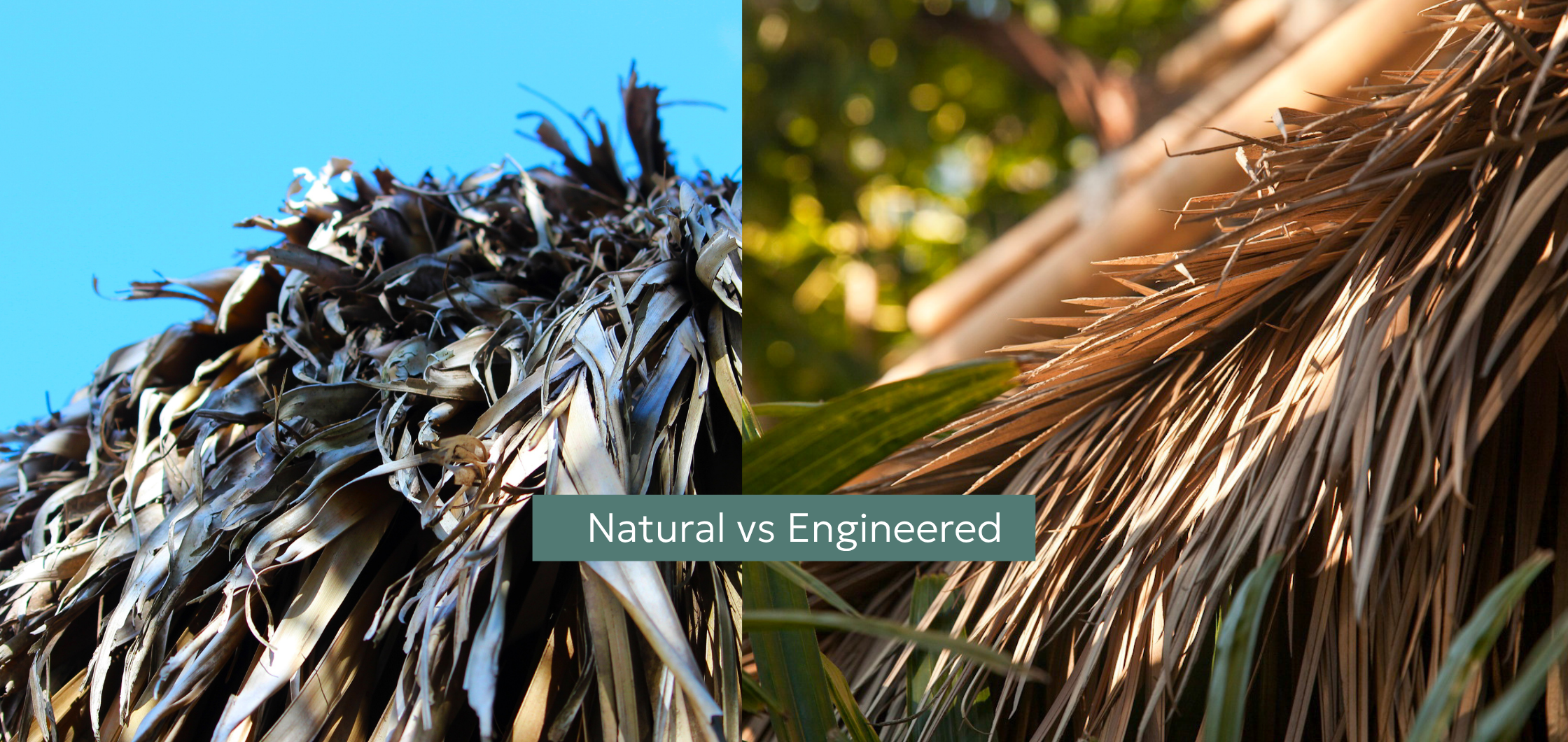
Synthetic vs. Natural Thatch: What 20 Years Actually Costs
Endureed has been manufacturing synthetic — or engineered, as we like to call it — thatch for over 25 years. We have watched natural thatch installations age in real time across hundreds of project types, climates, and building codes. The data on what natural thatch actually costs over a 20-year period is not complicated — but it is consistently underestimated at the point of purchase. Let’s talk about synthetic thatch vs natural thatch cost and what it actually means for ROI when you break down the numbers.
What Total Cost of Ownership Actually Measures
Purchase price is a single line item. Total cost of ownership (TCO) is the full accounting: installation, scheduled maintenance, emergency repairs, replacement cycles, specialty labor, fire treatment, pest control, and whatever operational disruption comes with re-roofing a structure mid-life.
For natural thatch, those additional costs are substantial. For engineered thatch, they are effectively zero. The divergence between the two compounds with every passing year.
The 20-year window is not arbitrary. Endureed’s Performance line carries a 20-year warranty. That warranty period is the useful life guaranteed for an Endureed Performance roof. Over that same two decades, a natural thatch roof will have passed through at least one — and in most climates, two — complete replacement cycles, in addition to years of continuous maintenance expense.
The Natural Thatch Cost Stack
To understand why natural thatch’s real cost exceeds its sticker price, you have to account for every category of spend that follows installation.
Installation. Natural thatch requires a master thatcher — a specialist trade with a limited supply of qualified practitioners. That scarcity drives labor costs significantly higher than standard roofing work. Material sourcing adds further complexity; the reed, palm, or straw used in natural thatch is an agricultural product with variable availability and freight cost depending on the project location.
Annual maintenance. A natural thatch roof requires regular professional attention. Annual inspections are standard practice, running several hundred dollars per visit. Annual cleaning — combing and brushing to clear debris and prevent moss or algae from sealing the surface — adds further cost. Moss and algae buildup is not cosmetic; it prevents the thatch from drying after rain, accelerating rot and shortening the roof’s effective life. Fire retardant reapplication is a recurring requirement in most jurisdictions, as the initial treatment applied at installation degrades over time and must be renewed.
Pest and vermin control. Natural thatch is an organic nesting material. It attracts birds, rodents, and insects. Ongoing pest control is not optional for most commercial installations — it is a budget line that recurs indefinitely.
Ridge replacement. The ridge of a natural thatch roof — the exposed peak — wears faster than the main body. In most climates, ridge replacement is required every eight to twelve years, at costs that vary by roof size and complexity but regularly reach several thousand dollars for commercial-scale installations.
Partial repairs. Between full replacement cycles, sections of natural thatch will degrade unevenly. Storm damage, localized pest activity, and differential exposure to sun and moisture all produce areas that require rethatching before the main body of the roof is due for replacement. These repairs require a qualified thatcher and are priced accordingly.
Full replacement. Natural thatch in a tropical or subtropical climate — the context in which most commercial engineered thatch installations occur — typically requires full replacement every five to seven years. In more temperate or arid climates, that interval may extend to ten years under ideal conditions. Over a 20-year horizon, that means between two and four complete re-roof events. Each event restarts the material and labor cost clock from installation day one.
The cumulative total of these costs over two decades is not modest. Endureed’s own documented case history includes a 6,100-square-foot natural thatch installation at an amusement park that exceeded $200,000 in cost within eight years of initial installation. The same roof in Endureed engineered thatch would have been under $100,000 over that same period — and would have required no maintenance expenditure whatsoever.
The Engineered Thatch Cost Stack
By comparison, the engineered thatch cost model is straightforward.
Installation. Engineered thatch installs like a shingle system. It does not require master thatcher expertise, which expands the available contractor pool and reduces labor cost relative to natural thatch. Installation is faster, reducing project timeline and associated costs.
Ongoing maintenance: zero. Endureed engineered thatch requires no annual cleaning, no fire retardant reapplication, no pest control, and no moss or algae treatment. It is manufactured to resist all of those failure modes by design. The maintenance line disappears from the budget entirely.
Repairs: zero. Engineered thatch is not vulnerable to the localized degradation that creates mid-cycle repair needs in natural thatch. It does not rot, it does not attract nesting animals, and it does not require rethatching as material compresses or thins. The cost of reactive repair over the product’s life is, for most installations, zero.
Replacement: not required within warranty period. Endureed Performance products carry a 20-year warranty. The cost model for a 20-year horizon is one installation event. That is the entire stack.
Where the Lines Cross
The crossover point — where engineered thatch becomes less expensive than natural thatch on a cumulative basis — typically arrives in under five years. The exact timing depends on the initial installation cost differential and the maintenance intensity required by the project’s climate and building code context.
In tropical climates, where natural thatch degrades fastest and fire code requirements are most demanding, the crossover is earliest. In commercial hospitality contexts, where disruption costs from re-roofing events are factored in, the cumulative advantage of engineered thatch is further magnified.
After 20 years, the documented cost gap in comparable commercial installations routinely reaches several hundred thousand dollars. The upfront premium for engineered thatch — which in many cases is modest or nonexistent relative to the total project cost — is recovered well before the halfway point of the roof’s warranted life.
What the Numbers Do Not Capture
The TCO comparison above addresses direct costs. It does not capture several categories of value that tilt the calculation further toward engineered thatch.
Operational continuity. Re-roofing a commercial structure — a resort pavilion, a restaurant, a zoo attraction — means scheduling a construction event that disrupts operations, displaces guests, and requires coordination with a specialist contractor whose availability is not guaranteed. Engineered thatch eliminates this entirely.
Insurance. Natural thatch carries higher fire risk and correspondingly higher insurance premiums in most markets. The ongoing cost differential varies by insurer and jurisdiction, but it is a real and recurring expense that belongs in any honest TCO calculation. In some markets, insurance companies won’t insure natural thatch at all.
Code compliance certainty. Endureed Performance and Premium products carry Class A fire ratings and 200 MPH wind ratings. Natural thatch achieves fire compliance only through regular chemical treatment that degrades and requires reapplication. The cost and liability exposure associated with maintaining that compliance over time is not negligible — particularly in commercial environments where code audit is periodic.
Specifier confidence. For architects and developers, warranted performance data is the foundation of any specification decision. A 20-year warranty from the original engineered thatch manufacturer is a document. An estimate of how long natural thatch might last under favorable conditions is not.
Selecting the Right Engineered Thatch Product
Endureed’s product architecture is designed to put the right product in the right application — with no ambiguity about which is which.
Basics — 10-year warranty. In stock. Zero maintenance. The right choice for homeowners, backyard builds, and residential applications where commercial-grade fire and wind specification is not required.
Performance — 20-year warranty. Class A fire rated. 200 MPH wind rated. Endureed FlameCore Technology. The standard for commercial and higher-end residential projects where full performance specification is required.
Premium — 30-year warranty. Class A fire rated. 200 MPH wind rated. Endureed FlameCore Technology. Made to order in six distinct styles. The specification-grade product for resort, hospitality, and high-end immersive environments.
For any application where the 20-year TCO comparison in this article applies — commercial construction, resort and hospitality, parks and zoos, food and beverage — Performance or Premium is the correct starting point.
The Bottom Line: Who Wins in Synthetic Thatch vs Natural Thatch Cost
Natural thatch costs what it costs at installation. Engineered thatch costs what it costs over its warranted life. Those are fundamentally different calculations, and only one of them reflects what a building owner actually spends.
The company that invented the engineered thatch category — and has spent 25 years refining it — has a clear view of both sides of that comparison. The numbers favor engineered thatch at year one. They become decisive by year five. At year twenty, there is no comparison left to make.
Related reading: Thatch Roofing Cost Comparison | Contractors: Natural vs. Synthetic Thatch