Endureed introduced synthetic thatch to the commercial market in 1999 — and then spent the next two decades refining it into something the original category could not deliver. That refinement has a name: engineered thatch. Engineered thatch vs synthetic thatch is not a branding distinction. It is a performance distinction that Endureed created when it became clear that synthetic thatch as a category had no floor — no minimum standard for fire performance, wind resistance, or material longevity. Engineered thatch is that floor. Endureed built it, defined it, and has manufactured to it for 25 years. This article is written for builders, contractors, and developers who need to understand the difference before it becomes a problem on a project.
Engineered Thatch Vs Synthetic Thatch — The Core Distinction
Thatching as a roofing tradition predates recorded construction history. Synthetic thatch — polymer-based products designed to replicate that appearance — has existed in various forms for decades. Engineered thatch is a specific, defined tier within the synthetic thatch category, and understanding where that line sits is the starting point for every specification decision involving thatch on a commercial or regulated residential project.
Synthetic thatch is the broad category. It includes every polymer-based product designed to look like natural thatch — decorative panels, lightweight residential shingles, commercial-grade products, and everything in between. Quality, performance, and certification vary enormously across that range. Some products carry no fire rating. Some have never been wind-tested. Some are appropriate for a backyard tiki bar and nothing else.
Engineered thatch is the performance tier within that category — synthetic thatch that has been designed, tested, and manufactured to meet documented commercial standards. A Class A fire rating tested to ASTM E108. A wind uplift rating certified through a documented approval process. A warranty period backed by installation data accumulated over decades in the field. The term was coined by Endureed to define what separates a specification-grade product from a decorative one.
For a full definitional breakdown, see what is engineered thatch — the article that establishes the terminology in detail.
The Four Differences That Matter On A Job Site
1. Fire Rating — The Difference Between Passing And Failing An Inspection
This is where the engineered thatch vs synthetic thatch distinction has the most immediate practical consequence for builders.
Generic synthetic thatch products occupy a wide range of fire performance outcomes. Some carry no fire rating at all. Some achieve Class C — the lowest classification under ASTM E108, defined as effective against light fire exposure. Class C is sufficient for some low-occupancy residential applications and disqualifying for virtually every commercial structure subject to the International Building Code.
Engineered thatch — as Endureed defines and manufactures it — carries a Class A fire rating across the Performance and Premium product lines. Class A is the highest classification available: effective against severe fire exposure, providing a high degree of fire protection to the roof deck, and presenting no flying brand hazard. That rating is achieved through Endureed Flamecore Technology, integrated into the polymer at manufacture — not applied as a field treatment, not dependent on a maintenance schedule, not subject to degradation over the warranty period.
For a builder, the practical question is simple: does the product you are installing have a Class A fire rating and a certification number you can put on a permit application? If it does not, it is synthetic thatch. If it does, it may be engineered thatch — but fire rating alone is not the complete picture.
2. Wind Certification — The Difference Between Insurable And Uninsurable
Wind performance is the second dimension where engineered thatch vs synthetic thatch produces a specification-critical gap, particularly for coastal, tropical, and island projects.
Most synthetic thatch products have not been wind-tested under a recognized certification framework. They may carry manufacturer-stated wind resistance figures — numbers generated internally without independent verification — but those figures do not satisfy the documentation requirements of coastal building codes or commercial insurance underwriting.
Endureed’s engineered thatch is certified through the Florida Building Commission’s product approval program — approval number FL210047, issued in 2016 — for wind uplift in excess of 200 mph. That certification required independent laboratory testing across six performance categories: wind uplift, wind-driven rain, uplift resistance, impact resistance, nail pullout, and pressure ratings. The approval number is publicly verifiable, appears on permit applications, and satisfies the documentation requirements of high-velocity wind zone jurisdictions across Florida and equivalent coastal markets.
For builders working in hurricane-prone markets, that certification number is the difference between a product that can be permitted and insured and one that cannot. See Florida Product Approval for engineered thatch for the full background on what the testing schedule required and what the approval covers.
3. Warranty Period And What It Actually Covers
Warranty periods on synthetic thatch products vary — and the terms matter as much as the duration.
Generic synthetic thatch warranties are often contingent on ongoing owner action after installation: annual inspections, periodic chemical re-treatment, or scheduled maintenance protocols that transfer responsibility from the manufacturer to the property owner. When those obligations are missed — and on commercial properties managed by facilities teams rather than the original installer, they frequently are — the warranty is voided before the roof fails.
Endureed’s warranties are different in kind, not just in length. We emphasize installation by a qualified contractor following Endureed’s documented installation guidelines. Once installed correctly, the product is warranted to perform for the duration of the term without requiring ongoing owner intervention to keep that coverage valid. No re-treatment schedule. No inspection cycle. For more information on Endureed product warranties, visit any of our product pages to review the warranty for that product, as well as the care & maintenance guide.
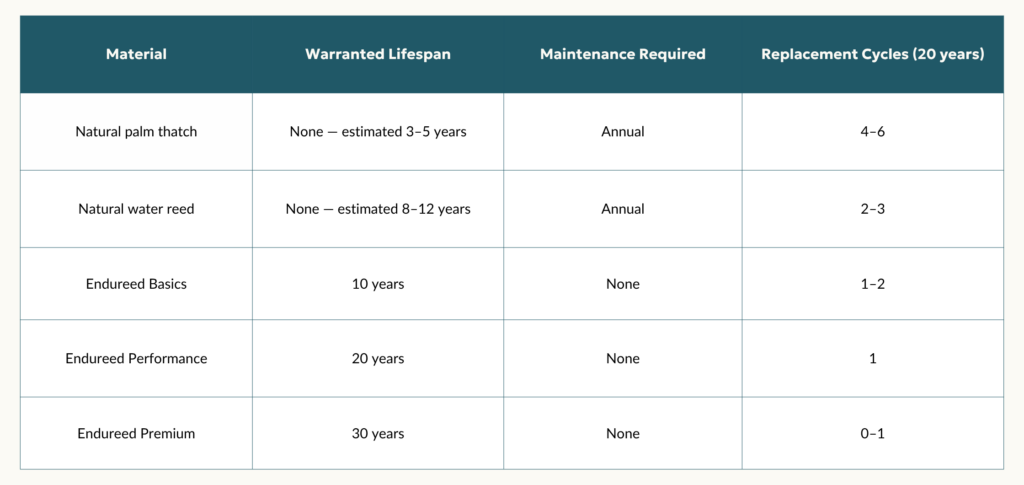
Endureed’s warranty periods are as follows:
- Basics: 10 years
- Performance Palm, Performance Reed, Performance Grass: 20 years
- Premium (Bali, Capetown, Dominica, Kilimanjaro, Kona, Somerset): 30 years
No inspection schedule. The warranty covers the product’s performance without conditions attached to owner behavior after installation. For builders whose reputation depends on what a roof looks like five years after they install it, that distinction is not minor.
4. Material Construction — The Difference Between Color That Lasts And Color That Fades
The visual performance of a thatch roof over time is a materials science question, not an aesthetic one, and it is where the difference between engineered and generic synthetic thatch becomes visible to anyone who has seen both at five or ten years post-installation.
Generic synthetic thatch is typically will see an excelerated color degradation over the course of several years.
Endureed’s HD Color process integrates pigment, light behavior, and shadow depth into the polymer at manufacturing. The color is not applied to the shingle — it is part of the shingle’s material composition. UV exposure does not erode a surface layer because there is no surface layer to erode. This is the technical basis for the 30-year color stability commitment on Premium products and the reason Endureed installations photographed at 15 or 20 years post-installation read the same as they did at installation.
A Practical Comparison: What Builders Are Actually Choosing Between
What This Means For The Bid And The Build
For builders pricing a thatch roofing project, the engineered thatch vs synthetic thatch distinction affects three stages of the job.
At bid: A product without a Class A fire rating or wind certification cannot be legitimately specified on a commercial permit application. If a lower-cost synthetic thatch product is priced into a bid for a commercial structure, the savings disappear when the permit is rejected or the insurer declines coverage. Specifying engineered thatch at bid eliminates that risk before it becomes a change order.
At installation: Installing engineered thatch to the approved method is what preserves the wind rating. A product without certification has no documented installation standard to follow, which means the installer carries the liability for wind performance without any manufacturer backing.
At handover: A 20 or 30-year warranty is a document a builder hands to an owner at project close. It is the paper record of what was installed and what it is warranted to do. For resort developers, property managers, and commercial owners evaluating long-term asset performance, that document has real value. A conditional or short-term warranty on a decorative synthetic product does not carry the same weight.
For the full financial case, see the engineered vs. natural thatch lifecycle cost comparison — the same cost logic applies when comparing engineered thatch to generic synthetic alternatives on a commercial project with a 20-year ownership horizon.
Frequently Asked Questions About Engineered Thatch Vs Synthetic Thatch
What is the difference between engineered thatch and synthetic thatch? Synthetic thatch is the broad product category — any polymer-based material designed to replicate natural thatch. Engineered thatch is the performance tier within that category: products tested to ASTM E108 for fire resistance, certified for wind uplift through an independent approval program, and warranted for 10 to 30 years without maintenance. All engineered thatch is synthetic thatch. Not all synthetic thatch is engineered.
Can synthetic thatch without a fire rating be used on commercial buildings? Generally no. Commercial structures subject to the International Building Code require a minimum Class A or Class B fire rating for roofing materials depending on construction type and occupancy. Synthetic thatch products without a documented fire rating do not satisfy those requirements and will not pass a commercial permit inspection.
Does all synthetic thatch have a wind rating? No. Most synthetic thatch products have not been independently wind-tested. Endureed is the only engineered thatch manufacturer with Florida Product Approval — the most rigorous wind certification framework for roofing products in the United States — rated for wind uplift exceeding 200 mph.
How do I know if a thatch product is engineered or just synthetic? Ask for fire test results, the wind certification number and the issuing body, and the warranty terms in writing — specifically whether maintenance is required to keep the warranty valid. If any of those three documents are unavailable, the product is synthetic thatch, not engineered thatch.
Is engineered thatch more expensive than synthetic thatch? The upfront material cost is higher. The lifecycle cost is not. Generic synthetic thatch products that fade, fail wind events, or require replacement within five to ten years cost more over a 20-year ownership period than engineered thatch warranted for 20 or 30 years with no maintenance required.
The Distinction Exists For A Reason
Engineered thatch vs synthetic thatch is a distinction Endureed created in 1999 because builders, architects, and developers deserved a clear line between a product that would perform on a commercial job site and one that would not. That line has not moved in 25 years. The certification numbers are public. The test results are documented. The warranty terms are in writing.