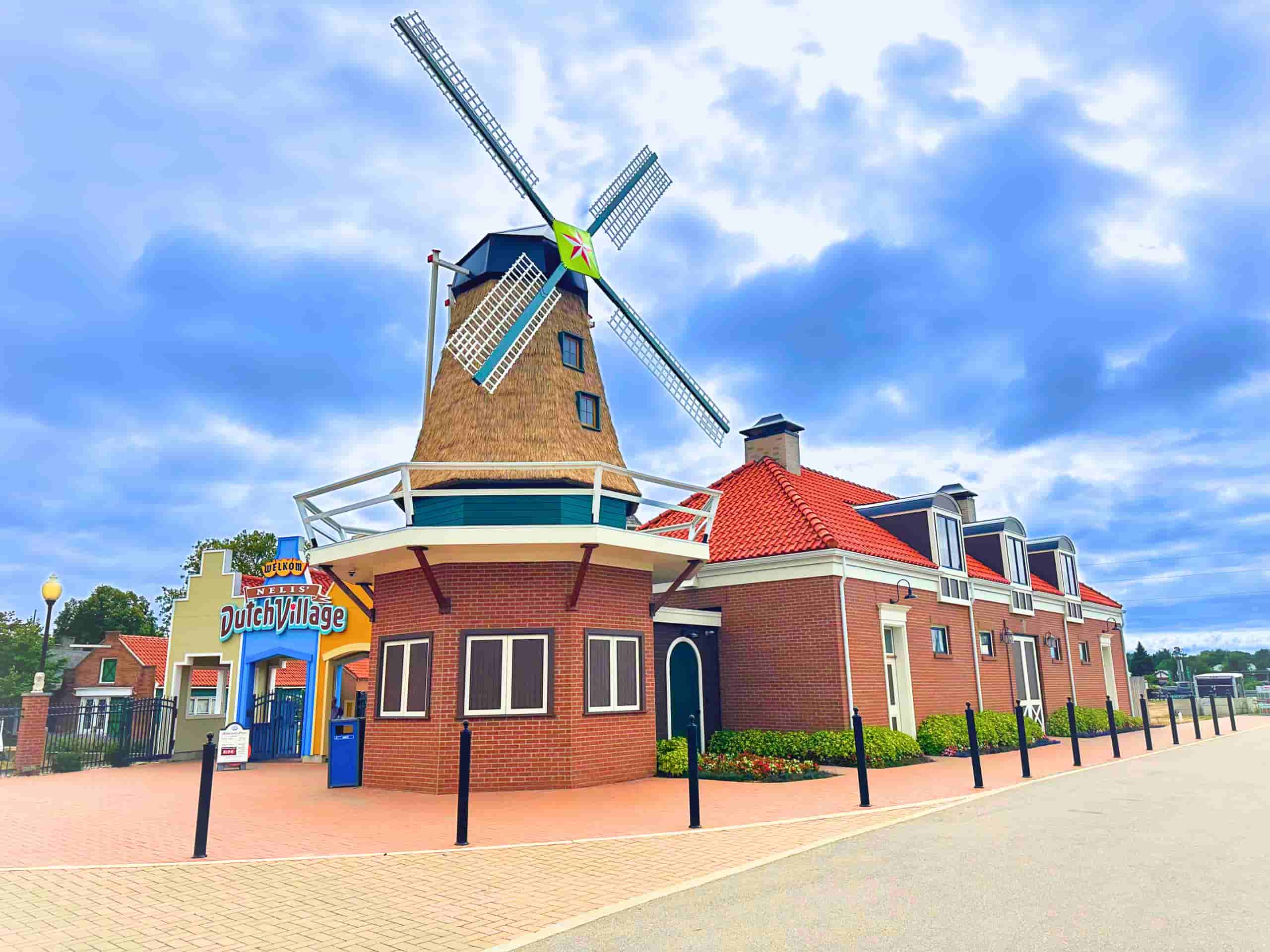
A Windmill That Tells the Whole Story
When Harry Nelis Jr. and his brother Fred built the first structure on their family’s US-31 property in Holland, Michigan in 1958, they weren’t thinking about legacy materials, nor did they consider applying authentic synthetic thatch to a windmill. They covered the windmill body in asphalt shingles. Practical, available, affordable. It was a bootstrapped operation. There was no grand plan, no outside investment, no deep pockets. Everything came from cash flow.
What they were building, though, would become one of the most beloved family attractions in West Michigan. Nelis’ Dutch Village, a 30-plus structure property representing the architecture, culture, and spirit of the Netherlands, grew from a roadside tulip bulb stand into a four-generation family institution. And at the center of it all, visible from the highway, stood that original windmill.
“Back in 1958, they just covered the body with asphalt shingles — easy, very available, and cheap. But not authentic at all.” — Joe Nelis
The windmill was more than a landmark. It was the face of something the Nelis family had built through nearly a century of adaptation, sacrifice, and genuine love for what Dutch culture represents. When the fourth generation decided to restore it; not just repair it, but truly restore it, the material decision carried weight that went well beyond roofing specs.
100 Years of Roots, One Decision Point
The Nelis family story begins in Beverwijk, Netherlands, in 1910. Frederick Nelis sent his 17-year-old son Harry across the Atlantic on the S.S. Noordam with a simple mission: find good farmland in America. What followed was a journey through Missouri, Chicago, and eventually Holland, Michigan, where the family put down roots that have held for over a century.
By the late 1930s, the Nelis tulip farm had become a destination. As tourist traffic grew along Lakewood Boulevard, Harry Sr. saw the opportunity clearly: all those people sitting in their cars, not spending money. In 1952, the family purchased 40 acres along the newly constructed US-31 highway. Fred and Harry Jr. built the first building. The windmill went up. People turned off the highway to see it.
“If you put up a Dutch-looking building along the side of the highway, the windmill on the top of it, people will turn off the highway and say — hey, what’s that?”
Over the decades, Nelis’ Dutch Village grew into something rare: a place with genuine soul. Street organs hand-selected from the Netherlands. A canal. Carousel. Costumed klompen dancers. Thirty-plus structures representing different Dutch provinces. A restaurant that ran for decades because tourists got hungry and the Nelises couldn’t turn anyone away.
They survived the 1974 gas rationing year. They outlasted casino competition that nearly killed their bus traffic in the 1990s. They reinvented the business in 2007. They reopened after a 2020 that brought in $43.95 on a Saturday during Tulip Time. They didn’t just survive. They kept building.
So when Joe Nelis and the fourth generation decided to restore the windmill and move it to the newly designed De Molenpoort (the windmill entrance building), the stakes were real. This wasn’t a renovation project. It was a statement about what the family was protecting.
The Right Material for the Right Moment
The original windmill had a complicated material history. Asphalt shingles gave way to cedar shakes, also inauthentic to Dutch construction, and poorly maintained. By the time the team began the 2025 restoration, the structure needed more than new roofing. It needed something that could stand up to Michigan winters, hold its appearance over time, and do justice to the authenticity the family was working to restore.
Dutch mills, as Joe noted, are rarely thatched. Reed roofs in the Netherlands are expensive and reserved for the most prestigious structures; a genuine status symbol. When they do appear, they’re unmistakable: layered, textured, warm. The kind of material that makes a windmill look the way a windmill is supposed to look.
Dutch Village had experienced natural imported reed once before. In the 1970s, the family installed a natural reed roof on the Queen’s Inn Restaurant entrance. It was beautiful. It also degraded badly under Michigan winters and was eventually removed. The lesson was clear: authentic aesthetics without durable performance isn’t a long-term solution.
“We were thrilled to find Endureed. We absolutely wanted it on the body of the mill. Secondary to mirroring that most Dutch mills have reed bodies, was the fact we wanted to pay homage to the Queen’s Inn Restaurant reed roof entrance.” — Joe Nelis
Endureed offered what natural thatch couldn’t: the look of authentic Dutch reed with the performance to withstand a Great Lakes climate, season after season. For a family that had spent 70 years choosing materials carefully, always weighing cost, authenticity, and longevity, it was the right answer at the right moment.
The Restoration
The project wasn’t simple. The windmill had to be lifted from its original building when the Queen’s Inn Restaurant structure was demolished in 2017. It was stored for several years before the new De Molenpoort building was designed around it.
When restoration began, the team found hidden cracks and damage that required careful attention. The fins; which had been reversed at some point during an earlier repair, causing the mill to spin clockwise instead of the authentic Dutch counter-clockwise, were flipped back to their correct orientation. The handrail was raked out at the proper Dutch angle. In April 2025, the fins were reinstalled.
And the body of the mill; the piece that visitors see from the highway, the face of Dutch Village for 70 years, was wrapped in Endureed engineered thatch.
The result is a windmill that looks the way it was always meant to look. Authentic to Dutch architecture. Honoring the natural reed tradition the Nelis family tried to introduce in the 1970s. And built to last through every Michigan winter ahead using Endureed’s Premium Somerset line!
What Longevity Means to a Four-Generation Family
Joe Nelis said something in his message that captures the Dutch Village story better than any project brief could:
“I’ve been living it, so I didn’t think that our story is all that impressive. But hearing you say it, well… maybe…”
That’s what 70 years of building something looks like from the inside. You’re too close to it to see it clearly. The junk cars parked in an empty lot to make it look like someone was open. The station wagon trip to New York to haul a street organ back from the docks. Closing up at 5:00 and turning the lights back on because a family from out of town wanted wooden shoes and you couldn’t turn them away.
It accumulates into something extraordinary but only if the structures hold. Only if the materials last. Only if each generation can pass something worth protecting to the next.
That’s what a material decision means for a place like Nelis’ Dutch Village. It’s not a roof spec. It’s a choice about what the next 70 years will look like for a synthetic thatch windmill and the iconic Dutch Village.
Endureed is honored to be part of it.
Ready to see what authentic synthetic thatch roofing looks like on your project? Explore Premium Somerset or request a sample to experience the material firsthand.