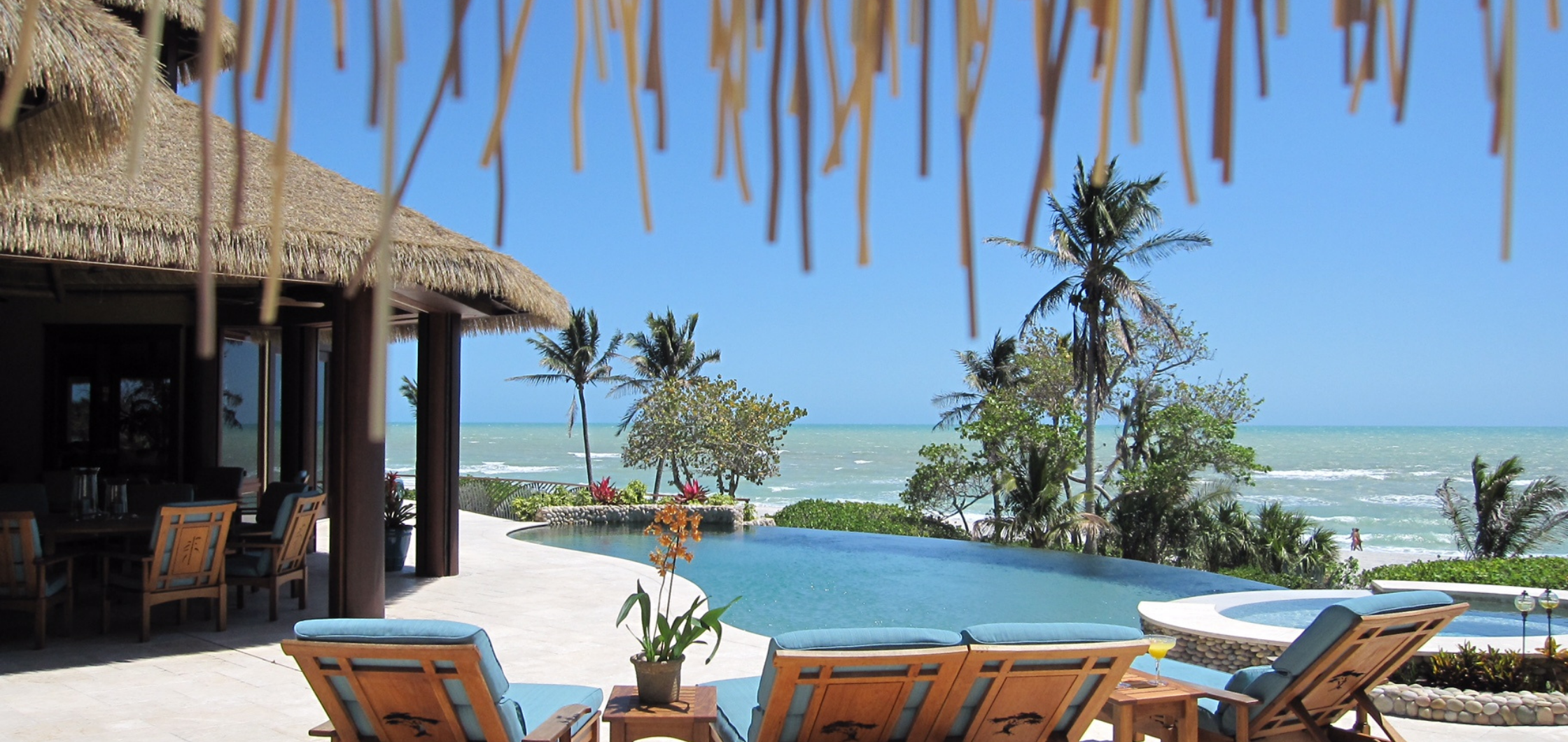
Commercial thatch roofing coastal environments — performance, code, and specification
Endureed has been manufacturing engineered thatch since 1999, and coastal commercial construction is where that engineering record is most directly tested. Commercial thatch roofing coastal projects introduce conditions that disqualify most roofing materials outright: salt air corrosion, sustained hurricane-force wind, UV intensity compounded by water reflection, and building code requirements that are among the strictest in the world. Engineered thatch — when manufactured to commercial specification — is one of the few aesthetic roofing materials that meets all of them. This article explains what coastal conditions actually demand, what the specification criteria are, and how Endureed’s products are documented to perform.
Why Coastal Environments Demand A Different Specification Standard
Coastal construction operates under a set of environmental and regulatory pressures that inland projects do not encounter at the same intensity. A roofing material that performs adequately in a suburban commercial environment may fail within years — or months — when exposed to the combined stressors of a coastal site.
The four primary performance demands for commercial thatch roofing coastal applications are:
Salt air exposure. Coastal air carries elevated concentrations of sodium chloride that accelerate corrosion in metal fasteners, degrade surface coatings, and break down organic materials. Natural thatch — already prone to rot and pest infiltration — degrades significantly faster in salt air environments. Polymer-based engineered thatch is chemically inert to salt air. The material does not corrode, absorb moisture, or react to atmospheric sodium chloride over time.
Wind uplift under hurricane conditions. Coastal structures in hurricane-prone regions — the Gulf Coast, Atlantic seaboard, Caribbean basin, and Pacific island markets — are subject to wind loads that standard roofing products are not designed to withstand. The Florida Building Commission’s product approval program sets the benchmark: products approved under this framework have been tested across wind uplift, wind-driven rain, impact resistance, nail pullout, and pressure ratings under documented laboratory conditions.
UV intensity amplified by proximity to water. UV radiation at coastal sites is intensified by reflective surfaces — open water, white sand, and light-colored architectural materials all increase the UV load on a roof relative to an equivalent inland site. Surface-pigmented synthetic thatch products fade measurably faster in these environments. Endureed’s HD Color process integrates pigmentation at the polymer level, not as a surface treatment, which is why its color stability is warranted for decades rather than years.
Building code compliance in high-velocity wind zones. Coastal jurisdictions — particularly in Florida, the Gulf states, and island territories — apply wind code requirements that exceed the base International Building Code. Roofing materials specified for these projects must carry documented wind ratings, not estimated performance ranges. Code officials and insurers require certification numbers, not manufacturer claims.
What Commercial Code Compliance Requires For Coastal Thatch Roofing
Thatching has a centuries-long history as a coastal and tropical roofing tradition — but natural thatch cannot meet the code requirements of modern commercial construction in those same environments. The gap between traditional practice and current regulatory standards is where engineered thatch was developed to operate.
For commercial thatch roofing coastal projects in the United States, the minimum specification threshold requires:
- Class A fire rating — tested to ASTM E108, required for commercial occupancies under the International Building Code and NFPA standards
- Documented wind uplift rating — required for permitting in high-velocity wind zones; Florida Product Approval is the most rigorous benchmark available
- No organic material content — natural thatch is not permissible on commercial structures in most coastal jurisdictions due to fire code and pest control requirements
- Long-term warranty documentation — required for insurance underwriting on commercial hospitality and resort properties
Endureed’s Performance and Premium product lines satisfy all four requirements with documented certification numbers, not stated estimates. The Florida Product Approval for engineered thatch — approval number FL210047, issued in 2016 — is the specification document that closes the permitting question on coastal commercial projects in the most demanding regulatory environment in the country.
How Engineered Thatch Performs Against Coastal Stressors
Salt Air And Moisture Resistance
Endureed shingles are manufactured from PVC and high-density polyethylene (HDPE) — the same polymer class used in marine and coastal infrastructure applications for its resistance to moisture absorption, salt exposure, and biological degradation. The material does not rot, corrode, harbor pests, or absorb water. Installations in Caribbean island environments, Gulf Coast resort properties, and Pacific coastal sites have accumulated decades of performance data without salt-related degradation.
Wind Performance In Hurricane Conditions
Endureed engineered thatch is rated for wind uplift in excess of 200 mph under Florida Product Approval (#FL210047) — the equivalent of a Category 5 hurricane at its upper threshold. That rating was achieved through a documented test sequence covering six performance dimensions: wind uplift, wind-driven rain, uplift resistance, impact resistance, nail pullout, and pressure ratings. For a full breakdown of the testing methodology and what each category measures, see wind-resistant engineered thatch roofing.
The mechanical fastening method is central to wind performance. Each Endureed shingle is fastened individually through pre-formed nail indentations at a defined spacing, creating a distributed load path across the entire roof field. Unlike bundle-bound natural thatch — which fails as sections — the per-shingle fastening means that if one shingle is compromised, the surrounding field remains intact.
UV Stability Over Decades
At coastal sites with high UV index and reflective water surfaces, color stability is a long-term maintenance and appearance concern that affects both owner experience and asset value. Endureed’s HD Color process integrates pigment into the polymer matrix at manufacturing — the color is not applied to the surface of the shingle, it is part of the shingle. This is the technical basis for the Premium line’s 30-year warranty: the material that provides color stability is the same material that provides structural performance, and neither degrades independently.
Product Selection For Coastal Commercial Projects
Performance Palm, Performance Reed, and Performance Grass are the commercial specification standard. Each carries a 20-year no-maintenance warranty, a Class A fire rating under ASTM E108, and wind uplift certification exceeding 200 mph under Florida Product Approval. Performance is the product most frequently specified by architects and contractors on coastal commercial builds where permitting documentation and lifecycle cost modeling are primary decision factors.
Premium — available in six profiles: Bali, Capetown, Dominica, Kilimanjaro, Kona, and Somerset — carries a 30-year no-maintenance warranty and represents Endureed’s highest-fidelity engineered thatch. Each profile replicates a specific regional thatch tradition with the dimensional depth and color variation that distinguishes a specification-grade material from a decorative substitute. Premium is used on luxury coastal resorts, five-star hospitality properties, and cultural or destination environments where visual authenticity is subject to the same scrutiny as structural performance.
For the full range of commercial applications where engineered thatch has been installed and specified, see Endureed’s commercial market applications.
Frequently Asked Questions About Commercial Thatch Roofing In Coastal Environments
Is engineered thatch appropriate for commercial coastal construction? Yes. Endureed engineered thatch is Florida Product Approved for wind uplift exceeding 200 mph, carries a Class A fire rating under ASTM E108, and is manufactured from HDPE — a polymer that does not corrode, absorb moisture, or degrade under salt air exposure. It is the only thatch product with documented certification for coastal commercial construction.
What wind rating is required for coastal commercial roofing? Requirements vary by jurisdiction and wind zone classification, but coastal projects in Florida and equivalent high-velocity wind zones require products with documented wind uplift ratings and approval numbers. Endureed’s Florida Product Approval (#FL210047) satisfies those requirements with a rating exceeding 200 mph.
Can natural thatch be used on commercial coastal buildings? In most coastal jurisdictions, no. Natural thatch does not meet commercial fire code requirements, cannot be certified for wind uplift, and is classified as an organic material subject to pest and moisture degradation — all of which are disqualifying conditions for commercial occupancy permits in coastal environments.
How does salt air affect engineered thatch? Endureed engineered thatch is chemically inert to salt air. PVC does not corrode, absorb atmospheric moisture, or react to sodium chloride exposure. Fasteners specified for coastal installations should be 304 or 306 stainless steel to match the material’s corrosion resistance. The thatch itself requires no salt-specific maintenance or treatment.
Which Endureed product line is recommended for coastal resorts? For luxury coastal resort and hospitality applications, Premium is the recommended specification — 30-year no-maintenance warranty, Class A fire rating, 200 mph wind rating, and six regionally inspired profiles with the visual fidelity that resort-grade architecture requires. For commercial coastal builds where lifecycle cost and permitting documentation are the primary criteria, Performance is the standard specification.
Coastal Conditions Are A Specification Problem — Engineered Thatch Is The Answer
Commercial thatch roofing coastal projects do not need a material that merely survives the environment. They need one that was engineered for it — tested under the conditions it will face, certified by the authority that governs those conditions, and warranted by the manufacturer who has been installing it in those environments for 25 years. Endureed is that manufacturer, and the specification documentation to support every coastal commercial project is available before the first sample is requested.
Request coastal project profiles or speak with an Endureed project specialist.