How long does synthetic thatch last — materials, construction, and what actually determines lifespan
Endureed has been manufacturing engineered thatch since 1999, and the lifespan question is the one that separates a legitimate specification conversation from a decorative purchasing decision. How long does synthetic thatch last? The honest answer is: it depends entirely on how it was made. A surface-pigmented decorative panel installed on a backyard structure may look adequate for three to five years. An engineered thatch shingle with polymer-integrated pigmentation, a Class A fire rating, and a documented wind certification is warranted for 30 years with zero maintenance required. The gap between those two outcomes is not a matter of luck or environment — it is a matter of material science and manufacturing standard.
How Long Does Synthetic Thatch Last — A Working Answer
Definition: How long does synthetic thatch last
Synthetic thatch lifespan ranges from three to five years for surface-pigmented decorative products to 10, 20, or 30 years for engineered thatch manufactured to commercial performance standards. Endureed engineered thatch carries the following warranty periods with zero maintenance required: Basics — 10 years; Performance Palm, Performance Reed, Performance Grass — 20 years; Premium (Bali, Capetown, Dominica, Kilimanjaro, Kona, Somerset) — 30 years.
Thatching as a roofing tradition spans thousands of years across cultures — but natural thatch in a tropical coastal environment requires full replacement every three to five years. The development of engineered synthetic thatch was a direct response to that limitation: a material that replicates the appearance of natural thatch while lasting decades longer without maintenance intervention.
The lifespan of any synthetic thatch product is determined by four variables: the base polymer, the pigmentation method, the fire chemistry, and the fastening system. Understanding each one is how a builder, architect, or developer evaluates a product before it is installed — rather than discovering its limitations five years after the fact.
The Four Variables That Determine How Long Synthetic Thatch Lasts
Variable 1: Base Polymer — What The Shingle Is Actually Made Of
Not all synthetic thatch is made from the same material. The base polymer determines resistance to UV degradation, moisture absorption, temperature cycling, salt air exposure, and biological growth — the primary environmental stressors that shorten a roof’s functional life.
Endureed’s engineered thatch shingles are manufactured from high-density polyethylene (HDPE) — the same polymer class used in marine infrastructure, food-grade containers, and coastal construction applications for its resistance to moisture, salt, biological degradation, and UV exposure. HDPE does not absorb water, does not corrode, does not support mold or pest colonization, and does not react to the atmospheric sodium chloride present in coastal environments.
Lower-grade synthetic thatch products are often manufactured from standard polyethylene or PVC formulations without the UV stabilization packages required for decades of outdoor exposure. These materials degrade faster under continuous UV load, particularly in tropical and coastal environments where UV index is elevated by reflective water and sand surfaces.
The base polymer is the foundation of lifespan. Everything else builds on it.
Variable 2: Pigmentation Method — Why Color Stability Matters For Longevity
Color fading is the most visible indicator of synthetic thatch degradation, and it is where the difference between engineered and generic synthetic products becomes apparent to anyone who has seen both at five years post-installation.
Generic synthetic thatch is surface-pigmented: color is applied as a coating to the exterior of the shingle during or after manufacturing. UV exposure erodes that coating progressively. In high-UV environments — coastal sites, tropical climates, locations where water and sand amplify UV load — surface-pigmented products show measurable fading within two to three years and significant color loss within five.
Endureed’s HD Color process integrates pigment, light behavior, and shadow depth into the polymer matrix at manufacturing. The color is not applied to the shingle — it is part of the shingle’s material composition. There is no surface coating to erode because the pigmentation is structural, not topical. This is the technical basis for Endureed’s 30-year color stability commitment on Premium products: the same material that provides structural performance provides color stability, and neither degrades independently of the other.
How long does synthetic thatch last at the color level is therefore a direct question about pigmentation method. Surface-pigmented: three to seven years before visible degradation in most commercial environments. Polymer-integrated: the full warranty period, which for Endureed Premium is 30 years.
Variable 3: Fire Chemistry — Why It Affects Longevity, Not Just Safety
Fire chemistry is not typically discussed as a lifespan variable, but for synthetic thatch it is — because how a product achieves its fire rating determines whether that rating remains valid over time.
Generic synthetic thatch products that carry any fire rating often achieve it through field-applied chemical treatments: flame retardants sprayed or painted onto the shingle surface after installation. Those treatments must be renewed on a schedule — typically every two to three years — to maintain compliance. Between renewal cycles, fire performance degrades. In practice, on commercial properties where maintenance schedules are managed by facilities teams rather than the original installing contractor, renewal cycles are frequently missed.
Endureed Flamecore Technology integrates fire-retardant chemistry into the polymer during manufacturing. It is not a surface treatment. It does not require renewal. It does not degrade between maintenance cycles because there are no maintenance cycles. The fire performance is in the material from manufacturing day to the end of the warranty period, and it is tested to ASTM E108 — the standard test method for fire tests of roof coverings — not estimated or self-certified.
For a builder or property owner, this means that the Class A fire rating on an Endureed shingle is present at year one, year ten, and year twenty-five — without any action required to maintain it.
Variable 4: Fastening System — What Keeps The Roof On In A Wind Event
A synthetic thatch product’s lifespan is effectively zero if it leaves the roof in a hurricane. Fastening system design is the variable that determines whether a product survives wind events that would otherwise end its functional life prematurely.
Generic synthetic thatch products are often fastened using general construction methods — staples, adhesive, or standard nails applied without a documented spacing or load specification. These methods are not tested against wind uplift under a recognized certification framework, which means their performance in a significant wind event is unknown.
Endureed’s fastening system is specified as part of Florida Product Approval (#FL210047) — a certification that required independent laboratory testing for wind uplift exceeding 200 mph, administered through the Florida Building Commission’s product approval program. The fastening pattern, nail type, purlin spacing, and minimum exposure are all documented in the approval. Installing to that specification is what preserves the wind rating and, by extension, the product’s ability to remain on the structure for the full warranty period.
How Endureed’s Three Product Lines Compare On Lifespan
Endureed’s three product lines represent distinct lifespan commitments calibrated to application type and performance requirement.
Basics is designed for residential structures, backyard palapas, pool structures, and tiki huts. It carries a 10-year no-maintenance warranty — meaning zero re-thatching, zero chemical treatment, and zero maintenance of any kind is required to keep the warranty valid across that period. For residential applications where a decade of maintenance-free performance represents a significant improvement over natural thatch or generic synthetic alternatives, Basics is the appropriate specification.
Performance — available as Performance Palm, Performance Reed, and Performance Grass — is the commercial specification standard, carrying a 20-year no-maintenance warranty alongside a Class A fire rating and 200 mph wind certification. Performance is the product most frequently specified on commercial hospitality structures, regulated coastal builds, and resort secondary structures where code compliance and lifecycle cost modeling are part of the specification decision. For a detailed cost analysis of what that 20-year no-maintenance commitment means relative to natural thatch over the same period, see the engineered thatch lifecycle cost comparison.
Premium — available in six profiles: Bali, Capetown, Dominica, Kilimanjaro, Kona, and Somerset — carries a 30-year no-maintenance warranty. Premium represents Endureed’s highest-fidelity engineered thatch, with profile geometry, dimensional depth, and color variation calibrated to replicate specific regional thatch traditions at the level of scrutiny a luxury hospitality environment requires. The 30-year warranty is the longest available from any engineered thatch manufacturer, and it is backed by installation data from Endureed’s 25 years of commercial deployments in the most demanding environments the category operates in.
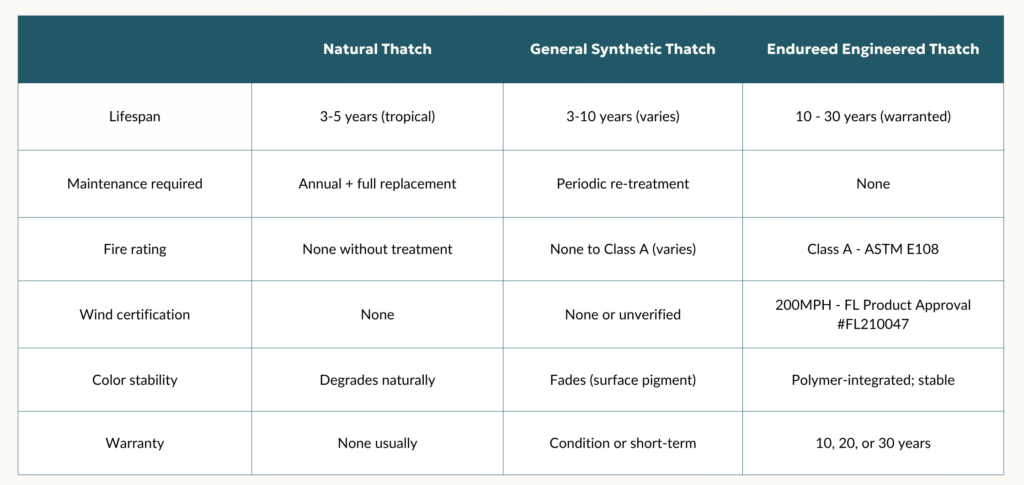
For a full breakdown of how these differences translate to total cost over a 20-year ownership period, see the natural vs. synthetic thatch comparison and the lifecycle cost analysis.
Frequently Asked Questions About How Long Synthetic Thatch Lasts
How long does synthetic thatch last? Synthetic thatch lifespan ranges from three to five years for surface-pigmented decorative products to 30 years for engineered thatch manufactured to commercial standards. Endureed Basics carries a 10-year no-maintenance warranty, Performance carries 20 years, and Premium carries 30 years — all with zero maintenance required across the warranty term.
How long does synthetic thatch last compared to natural thatch? Natural thatch in a tropical coastal environment requires full replacement every three to five years. Endureed engineered thatch is warranted for 10 to 30 years with no maintenance required — representing four to ten replacement cycles of natural thatch within the warranty period of a single engineered thatch installation.
What makes some synthetic thatch last longer than others? Four variables determine synthetic thatch lifespan: base polymer quality, pigmentation method, fire chemistry integration, and fastening system design. Products with polymer-integrated pigmentation, HDPE base material, factory-integrated fire chemistry, and a documented wind-rated fastening system outlast surface-pigmented, field-treated alternatives by decades in commercial environments.
Does synthetic thatch fade over time? Surface-pigmented synthetic thatch fades measurably within two to five years under continuous UV exposure, particularly in coastal and tropical environments. Endureed’s HD Color process integrates pigmentation into the polymer at manufacturing — there is no surface coating to erode, and color stability is covered by the product warranty.
Does the fire rating on synthetic thatch last? Only if it is integrated at manufacture. Field-applied fire treatments degrade between renewal cycles and require ongoing maintenance to remain effective. Endureed Flamecore Technology is integrated into the polymer at manufacturing and requires no renewal — the Class A rating tested to ASTM E108 is present for the full warranty period without any maintenance action.
Lifespan Is A Specification Decision, Not A Guess
How long does synthetic thatch last is a question with a precise answer — if the right product is specified. Endureed has been manufacturing engineered thatch to documented commercial standards since 1999, and every warranty period the company offers is backed by installation data from 25 years of deployments in coastal, tropical, hurricane-exposed, and high-UV environments. The lifespan figures are not estimates. They are warranty commitments with certification numbers attached.
For answers to additional specification questions, see common synthetic thatch questions or request Endureed’s full specification package before the design development phase closes.
Request a sample, a specification package, or a conversation with an Endureed project specialist.