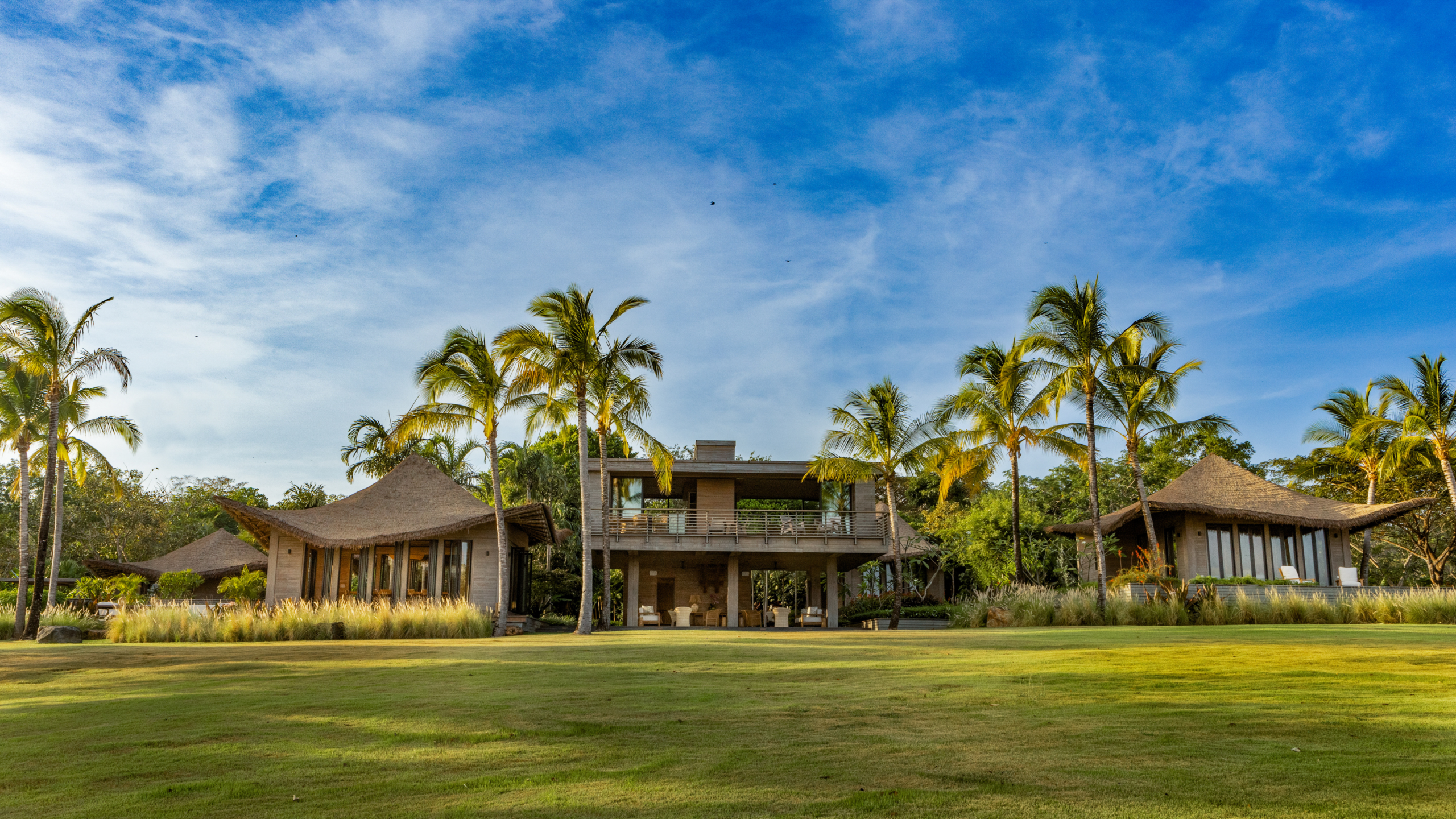
Featured image: Photographer: Emily Kinskey | Architect: IMKM
How is engineered thatch tested — fire, wind, and lifecycle performance explained
Endureed has been manufacturing engineered thatch since 1999, and every performance claim the company makes is backed by a documented test result. How is engineered thatch tested? The short answer: to the same standards applied to any commercial roofing material — fire resistance under ASTM E108, wind uplift, wind driven rain, and wind resistance under ASTM D3161, and lifecycle performance through warranty periods calibrated to real installation data in multiple jurisdictions. This article explains what each test measures, what Endureed’s results mean, and why those figures matter at the specification stage.
How Is Engineered Thatch Tested For Fire Resistance
Fire testing is the most consequential performance category for any thatch product — natural or engineered — because thatch’s historical association with fire risk is the primary objection architects, insurers, and code officials raise when it appears on a specification.
Endureed engineered thatch is tested to ASTM E108 — Standard Test Methods for Fire Tests of Roof Coverings — the same standard applied to asphalt shingles, metal roofing, and every other commercial roofing material subject to building code. ASTM E108 evaluates roof coverings across five test methods:
- Spread of flame test — measures how far and how fast flame travels across the roof surface under simulated wind conditions
- Burning brand test — places an ignited wood brand on the roof surface to measure resistance to ignition and fire penetration
- Flying brand test — measures whether the material generates burning projectiles that could spread fire to adjacent structures
- Intermittent flame test — evaluates performance under repeated flame exposure cycles
- Rain test — measures whether extended moisture exposure degrades fire performance
Class A is the highest classification available. It applies to roof coverings effective against severe fire exposure that afford a high degree of fire protection to the roof deck, do not slip from position, and do not present a flying brand hazard. Endureed’s Performance and Premium product lines carry a Class A fire rating across all five test methods.
Fire resistance in Endureed products is achieved through Endureed Flamecore Technology — a proprietary fire-retardant chemistry integrated into the polymer during manufacturing. It is not a field-applied coating, a chemical treatment scheduled for renewal, or a surface layer that degrades with UV exposure. The fire performance is in the material from the day it leaves the factory. For a deeper look at how this translates to installed performance, see Endureed’s fire-resistant thatch roofing.
Commercial structures including hotels, resorts, restaurants, and assembly occupancies are subject to the NFPA Life Safety Code, which establishes minimum fire performance requirements for roofing materials. A Class A rating satisfies those requirements without exception.
How Is Engineered Thatch Tested For Wind Resistance
Wind testing for roofing materials in Florida — one of the most demanding regulatory environments for building products in the world — is administered through the Florida Building Commission’s product approval program. Endureed — operating as Global Innovation, LLC — holds Florida Product Approval #FL21047-R2, evaluated against UL 1897 (2012), ASTM D3161, and TAS 105, and validated by an independent Florida-licensed professional engineer.
The approval process required documented test results across three recognized standards:
- UL 1897 — evaluates uplift resistance of roof covering systems under sustained wind load conditions
- ASTM D3161 — the standard test method for wind resistance of roofing shingles, evaluating shingle performance under wind tunnel conditions to confirm resistance to lift and displacement
- TAS 105 — Florida’s Testing Application Standard for wind-driven rain resistance, measuring the material’s ability to prevent water infiltration under combined wind and rain conditions representative of hurricane exposure
The result is a design pressure rating of -97.5 psf, corresponding to wind speeds in excess of 200 mph. That figure is not a marketing claim. It is a documented result from an independently validated evaluation report developed by a Florida-licensed professional engineer (Zachary R. Priest, PE-74021) and validated by a second independent engineer (Steven M. Urich, PE), with quality assurance administered through PRI Construction Materials Technologies, LLC.
Florida Product Approval is not a self-certification process. Every standard cited above was evaluated by an independent third party, and the approval number — FL21047-R2 — is publicly verifiable through the Florida Building Commission’s product approval database.
For the full background on what Florida Product Approval means and how Endureed achieved it, see Florida Product Approval for synthetic thatch.
How Is Engineered Thatch Tested For Lifecycle Performance
Lifecycle testing for roofing materials does not follow a single standardized protocol the way fire and wind testing do. In practice, lifecycle performance is validated through a combination of accelerated UV and weathering tests, long-term installation monitoring, and warranty commitment — which is the manufacturer’s stated confidence in the product’s durability over a defined period.
Endureed’s warranty periods are calibrated to installation data accumulated across 25 years of commercial and residential deployments in coastal, tropical, high-UV, and hurricane-exposure environments:
- Basics: 10-year warranty
- Performance Palm, Performance Reed, Performance Grass: Garantía de 20 años
- Premium (Bali, Capetown, Dominica, Kilimanjaro, Kona, Somerset): 30-year warranty
No maintenance is required across our products aside from general upkeep. There is no re-thatching schedule, no chemical re-treatment cycle, and no inspection requirement. To review our care guide, visit any of our product pages.
UV stability is a specific lifecycle variable worth addressing separately. Low-grade synthetic thatch products are surface-pigmented, meaning the color layer is applied as a topcoat and degrades as UV exposure erodes it. Endureed’s HD Color process integrates pigment, light behavior, and shadow depth into the polymer at manufacturing. The color is not on the material — it is the material. That is why Endureed can commit to a 30-year warranty on Premium without a maintenance or re-treatment schedule attached to it.
What These Test Results Mean At The Specification Stage
How is engineered thatch tested is a question that matters most when a project is moving from design intent to permitted construction. At that stage, three figures need to appear on a specification sheet without qualification:
Fire rating: Class A — ASTM E108. This satisfies commercial building code requirements in every jurisdiction that references the International Building Code, and meets NFPA Life Safety Code requirements for assembly and hospitality occupancies.
Wind rating: 200 mph — Florida Product Approved (#FL210047). This satisfies permitting requirements in Florida — the most stringent wind code environment in the United States — and is accepted as documentation of wind performance in most coastal jurisdictions nationally.
Warranty: 10, 20, or 30 years depending on product line — zero maintenance required. This is the lifecycle commitment that supports insurance underwriting, long-term cost modeling, and owner expectations on resort and commercial projects.
All three figures are available in Endureed’s specification documentation, which can be requested before a sample is ordered or a budget is submitted. See Endureed’s Performance and Premium product lines for product-specific specification data, or review the engineered thatch specification FAQ for answers to common permitting and code questions.
Frequently Asked Questions About Engineered Thatch Testing
How is engineered thatch tested for fire? Endureed engineered thatch is tested to ASTM E108 — the standard test method for fire tests of roof coverings — across five test methods including spread of flame, burning brand, flying brand, intermittent flame, and rain exposure. The result is a Class A fire rating, the highest classification available, achieved through Endureed Flamecore Technology integrated into the polymer at manufacture.
What wind rating does engineered thatch carry? Endureed engineered thatch is Florida Product Approved for wind uplift in excess of 200 mph. Florida Product Approval (#FL210047) was achieved in 2016 following a documented testing schedule covering wind uplift, wind-driven rain, impact resistance, nail pullout, and pressure ratings.
Does engineered thatch meet commercial building code for fire? Yes. A Class A fire rating under ASTM E108 satisfies the minimum roofing requirements of the International Building Code for commercial construction and meets NFPA Life Safety Code requirements for hospitality and assembly occupancies.
Is the fire resistance in engineered thatch permanent? Yes. Endureed Flamecore Technology is integrated into the polymer at manufacture — it is not a surface treatment or field-applied coating that diminishes over time. The fire performance does not require renewal and does not degrade with UV exposure or weathering.
Testing Is The Foundation Of Specification Confidence
How is engineered thatch tested is not an abstract compliance question. It is the foundation on which every specification, permit application, and owner conversation about thatch roofing rests. Endureed has been manufacturing to documented test standards since 1999 — longer than any other company in the category — and every performance figure the company publishes is traceable to a test result, a certification number, or a warranty commitment backed by 25 years of installation data.
If you are specifying engineered thatch for a commercial or hospitality project, request Endureed’s full specification package before the design development phase closes. The test results are the specification.
Request specification documentation or speak with an Endureed project specialist.